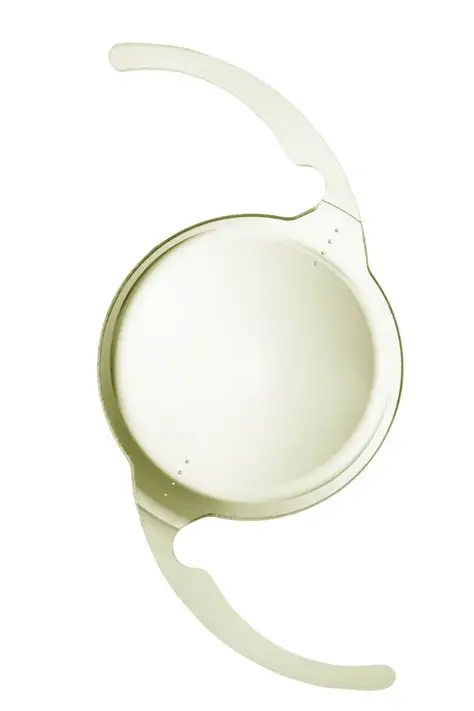
When preparing for cataract surgery you have several options to consider regarding your post-operative vision. Replacing a cloudy lens is no longer just about restoring clarity—it is also an opportunity to tailor how you see the world based on your daily activities.
At San Jose Eye Institute, we are excited to offer the Johnson & Johnson TECNIS PureSee intraocular lens. Here is everything you need to know about this lens.
Understanding Your Lens Options: First, it helps to understand the other major categories of lenses:
- Standard Monofocal Lenses: If you do not have astigmatism, these can provide excellent vision at a single distance (usually far away). However, only that distance is in focus, and everything else is blurry. You will still need glasses for intermediate tasks (like looking at a computer) and close-up tasks (like reading a book). The natural loss of up-close focusing is called presbyopia .
- Multifocal Lenses: These address presbyopia by using “diffractive” technology—essentially etching concentric rings onto the lens surface. One set of rings focuses far away, and the other focuses close up. While effective at providing a wide range of vision, these rings can sometimes cause nighttime glare or halos around lights.
The PureSee Difference: Continuous, Seamless Vision
The TECNIS PureSee is classified as an Extended Depth of Field (EDOF) lens. Instead of using diffractive rings, the PureSee lens features a proprietary, completely smooth surface pattern. While it does not have the extreme close-up focus of a multifocal, it provides a seamless range of vision, usually between distance and intermediate.
Tailoring the Lens to Your Lifestyle: The PureSee lens can be configured in a few different ways depending on your visual goals:
- Distance + Intermediate: Optimized for tasks like driving, watching TV, and viewing your computer screen or car dashboard without glasses.
- Intermediate + Near: For patients who prioritize up-close hobbies. This configuration allows you to see from your computer screen to a book without glasses, though you would require glasses for driving.
- Blended Vision: We can set one eye to cover distance-to-intermediate and the other to cover intermediate-to-near, creating a broader overall range of vision across both eyes.
Astigmatism Correction: For those with astigmatism, a PureSee Toric IOL is available to reduce astigmatism as well.
Functional Benefits: Night Vision and Low Light:
The unique design of the PureSee lens offers a couple of distinct clinical advantages in low-light environments:
- Minimizing Nighttime Glare: Because the lens surface is smooth and ring-free, its night-vision performance is comparable to a standard monofocal lens—the industry benchmark for minimizing glare and halos while driving at night.
- Maintained Contrast: This is the first EDOF lens that does not carry an FDA warning for loss of contrast sensitivity, meaning vision remain sharp and defined, even in dimly lit environments.
A More Forgiving Optical Design
Traditional multifocal lenses require a highly pristine ocular surface to perform optimally. If a patient experiences dry eyes or mild macular degeneration, a traditional multifocal lens can sometimes compromise visual quality.
The PureSee lens is much more forgiving. Because of its smooth optical design, it is often a viable option for patients with minor underlying eye conditions.
Finding the Right Fit at San Jose Eye Institute
Every eye is unique, and your vision plan should be too. We will help you determine if the TECNIS PureSee lens aligns with your lifestyle and vision goals.
Contact San Jose Eye Institute today to schedule your comprehensive cataract consultation.
Thank you for the information — I have the Vivity lens (an EDOF; implanted almost four years ago) and they are great: I have NEVER experienced halos, and I asked for as much closeup vision as possible … Very satisfied, but the PureSee sounds even better … Could you give any information on removing an IOL?
Hi Joseph,
Great question. As a general rule, it is not advisable to exchange an IOL once implanted unless it is causing problems, such as intolerable glare at night. There are significant risks with removing an IOL, and the benefits need to outweigh the risks. The Vivity IOL is a great lens. You are seeing well and you are happy. Any complication in exchanging the IOL could change that completely. Most doctors would recommend leaving the lens alone.
George Yang, MD